A coastal garden is shaped by more than its distance from the water. Salt spray, strong wind, sandy or salt-affected soil, intense reflected light and storm exposure can change dramatically across the same property, making the level of exposure one of the most important factors in the design.
Regional climate matters just as much. A beachfront garden in Florida faces different temperatures, storm patterns and plant choices from a coastal garden in California, New England or the Pacific Northwest, so successful planting begins with species suited to both the local coast and the specific microclimate.
This guide explains how to design a coastal garden, including how to evaluate salt and wind exposure, create layered shelter, work with sandy soil and drainage, choose regionally appropriate coastal plants, irrigate during establishment, protect dunes and sensitive areas, plan for storms and select materials that can withstand salt air.
What Is a Coastal Garden?
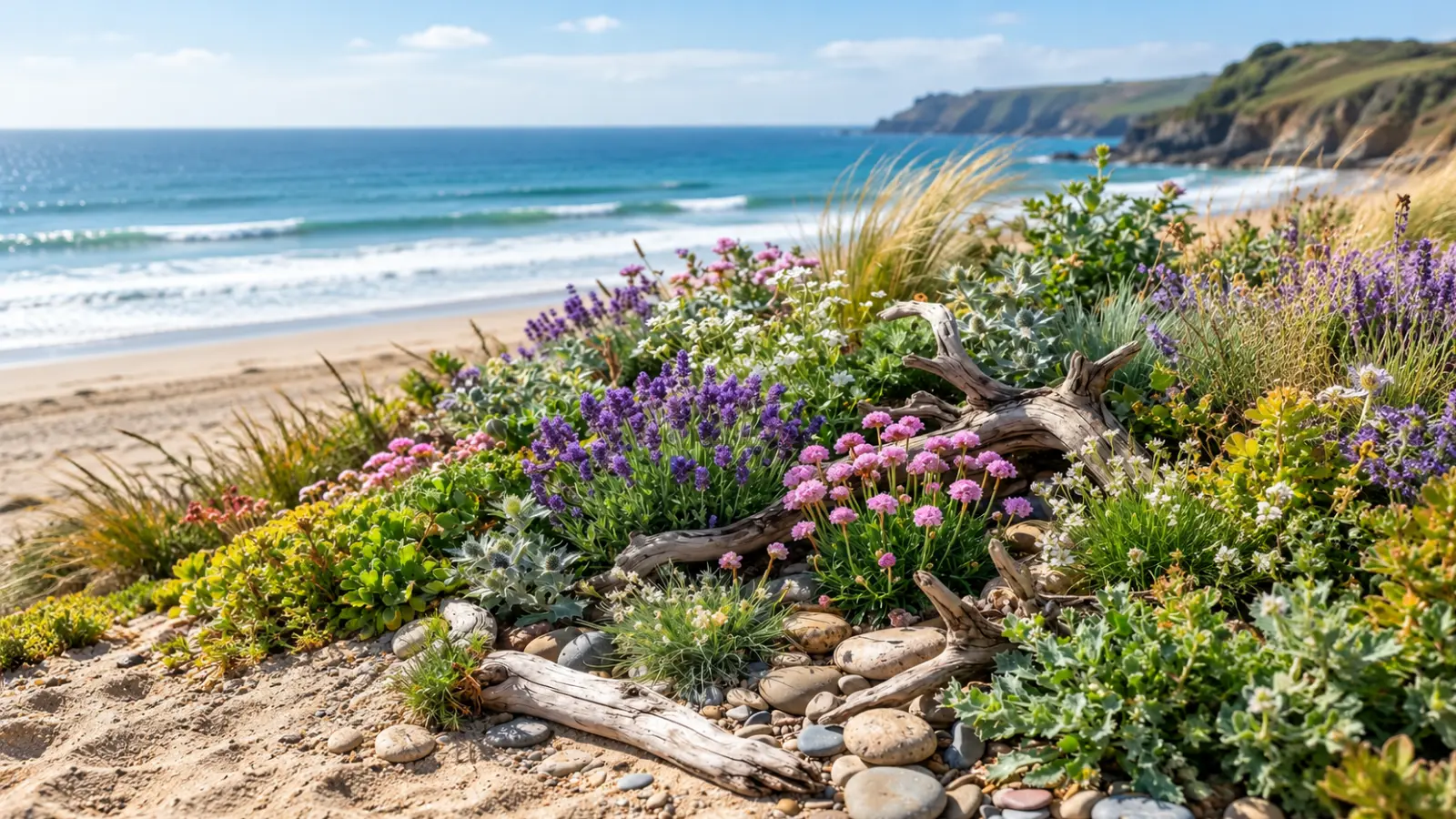
A coastal garden is a landscape planned for shoreline conditions such as salt spray, wind, sandy or rocky soil, limited freshwater and exposure to storms. It may be lush and layered, minimalist and gravel-based or designed closely around native dune and coastal plant communities.
“Coastal” does not describe one aesthetic. A seaside garden in Maine deals with different plant choices and winter concerns than a Gulf Coast garden in the same season, and a Pacific Northwest property may need to manage cool, wet winters rather than prolonged summer drought. The design should follow the actual environment, not a generic idea of what a beach garden looks like.
The garden’s position in the coastal landscape matters too. A planting near the beach, a protected yard behind a dune and an inland property close enough to catch salt during storms may all need different levels of tolerance — sometimes on the same block.
Direct vs. Indirect Salt Exposure
Salt reaches plants in more than one way, and understanding which type of exposure a site has is the first step in choosing the right plants and layout.
Direct exposure occurs when ocean spray or wind-driven salt regularly lands on leaves and stems. This is the most demanding situation and typically requires highly tolerant species with waxy, thick or small leaves that resist salt accumulation. Properties within about an eighth of a mile of the oceanfront — and sometimes farther during strong onshore winds or nor’easters — fall into this category.
Indirect exposure occurs farther inland or behind a protective feature such as a building, dune or established planting. Salt may still arrive during storms, but the concentration and frequency are lower. Plants that cannot handle direct spray may survive well in these sheltered areas if wind and soil conditions are also appropriate.
Salt can also accumulate in soil through repeated spray, salty irrigation water, storm flooding or poor drainage. A plant that tolerates salt on its foliage may not tolerate high soil salinity around its roots — the two types of tolerance don’t always go together. Soil salinity near the coast can exceed 16 dS/m in some areas, well above the range most plants handle comfortably. Check both types of exposure before selecting plants.
| Exposure | Typical Conditions | Planting Implication |
|---|---|---|
| Direct coastal exposure | Frequent salt spray, strong wind and blowing sand | Use highly salt- and wind-tolerant plants; layer shelter from the seaward side |
| Indirect coastal exposure | Occasional salt and wind, often reduced by buildings, dunes or mature planting | Use a wider plant palette while retaining regional suitability |
| Salt-affected soil | Salty irrigation water, flooding or repeated salt deposition | Evaluate root-zone salinity and drainage separately from leaf tolerance |
Salt damage on foliage typically shows up as scorched leaf margins, premature leaf drop or weak growth — but drought, wind and heat can cause similar symptoms and often occur alongside salt stress. A single symptom rarely points to one cause in a coastal garden.
Choose Plants by Coastal Region
There is no single national list of the best coastal plants. The appropriate species depend entirely on the regional climate, local habitat and the conditions on your specific property.
- Florida and the Gulf Coast: consider heat, humidity, hurricane exposure, salt spray, sandy soils and tropical or subtropical plant communities. Native beach sunflower, sea oats, sabal palm and sea grape can anchor plantings in appropriate zones.
- The Carolinas and the Southeast Atlantic coast: account for hot summers, storm exposure, coastal plain soils, humidity and occasional winter cold. NC State Extension’s salt-tolerant plant lists, divided by tolerance level, are a reliable regional starting point.
- California: distinguish cool marine influence from inland heat, drought, seasonal dryness, wildfire risk and diverse regional coastal habitats from the redwood coast to the southern Channel Islands.
- Pacific Northwest: consider cool wet winters, summer dryness in some areas, consistent wind, rocky shore conditions and a distinct native plant community that differs significantly from what grows along other American coasts.
- Northern Atlantic and New England coasts: evaluate salt, hard winter cold, freeze-thaw cycles, storm wind and short growing seasons. Species that thrive in Connecticut may not survive a Maine winter without protection.
Use regional Cooperative Extension Services, native-plant societies, state natural-resource agencies and reputable coastal nurseries to confirm plant choices. Check hardiness, mature size, salt tolerance rating, moisture needs and invasive status together — a plant can be regionally appropriate in one state and listed as invasive in another.
Study Wind, Sun and Microclimate
Wind is the central organizing force in a coastal garden. It increases water loss from soil and foliage, can tear leaves, break branches, loosen shallow roots and carry salt farther inland than most gardeners expect. Map prevailing wind directions for your site and identify places where buildings, fences, existing trees, dunes or landforms already provide meaningful shelter.
Sun exposure near water can be more intense than it looks, because light reflects off sand, water, pavement and pale walls. Plants near a south- or west-facing structure may experience more heat stress than the same species in an open bed. Observe the site across seasons and during both calm weather and storms before finalizing any planting plan.
Note where sand accumulates, where water collects and runs after storms and where cold air settles on still nights. A low spot may be protected from wind but more vulnerable to flooding, salt deposition or late-season cold. Coastal garden design works best when these microclimates are recognized as separate planting areas with different requirements, rather than treated as one uniform landscape.
Create Layered Wind Protection
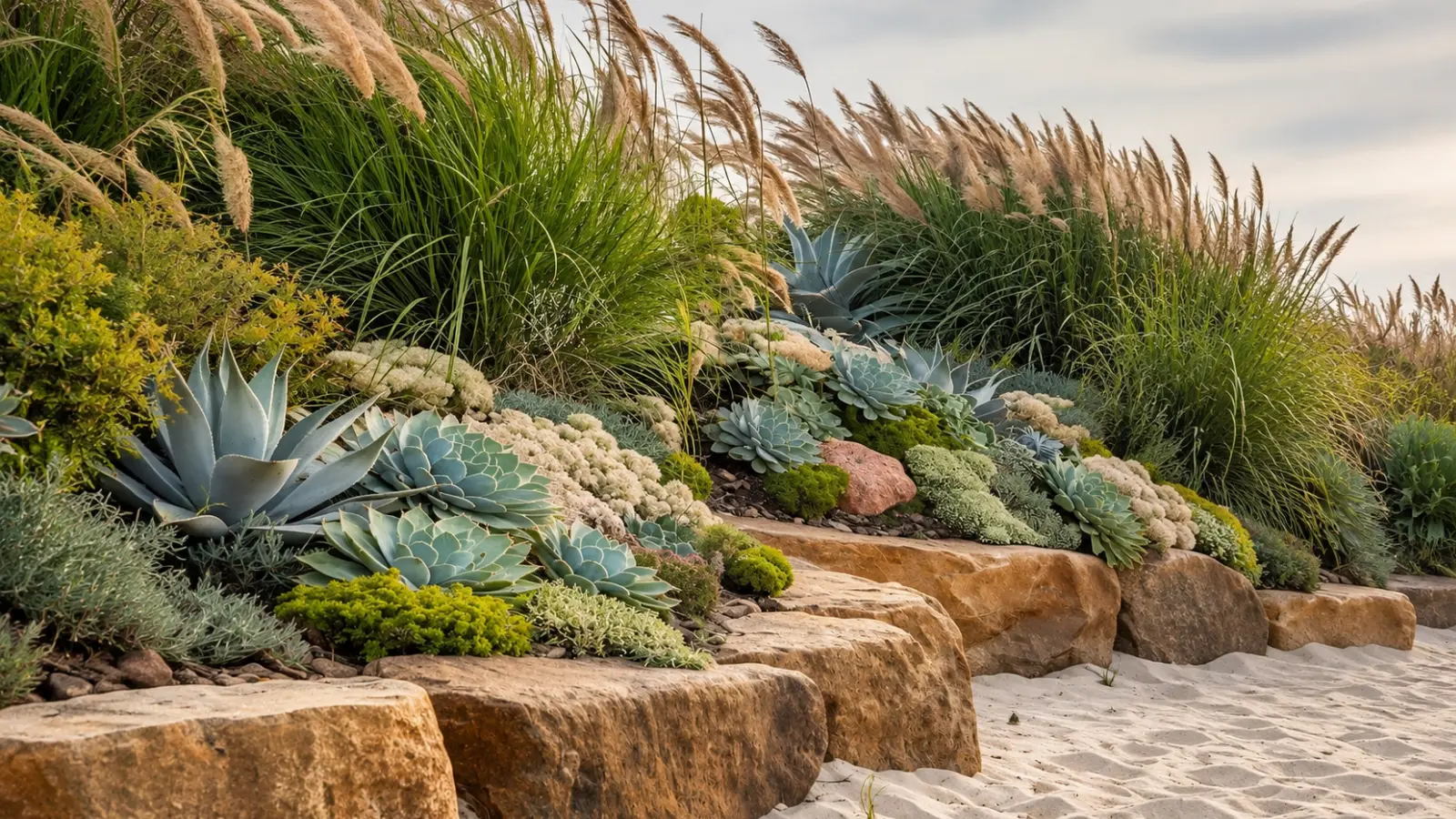
Layered shelter reduces wind exposure gradually, and the type of barrier matters as much as its location. A solid wall or close-board fence can create more turbulence on the leeward side than the original wind, because air deflected upward over the barrier drops back down with damaging force. A permeable barrier — a mixed hedge, slatted screen or staggered planting — filters and slows wind over a longer distance without that rebound effect. Research from the USDA National Agroforestry Center confirms that a permeable windbreak can protect an area up to ten to fifteen times its own height downwind.
Outer Layer
Use the most salt- and wind-tolerant shrubs, grasses or low-growing plants on the windward side. Their job is to absorb force, trap moving sand and reduce the salt load reaching plants behind them — not to create a rigid wall. Native dune grasses and tough coastal shrubs suited to your region are the most reliable choices here.
Middle Layer
Behind the outer planting, add larger shrubs or small trees where the site allows. Choose flexible, well-rooted species with mature sizes that won’t become top-heavy or unstable in storms. Stagger heights to create a gradual transition rather than a single abrupt barrier.
Protected Inner Layer
Use the sheltered side for plants with moderate salt tolerance, seating areas or more diverse plantings. Avoid placing delicate plants directly against a wall where wind accelerates around a corner or where reflected heat adds an additional layer of stress.
Wind protection that depends on new plants takes time. Use existing shelter while the planting matures, and consider temporary burlap screens or permeable fencing during the first one to two seasons while the living windbreak establishes. Do not assume a newly planted hedge can protect the garden through its first full season of storms.
Work With Sandy Soil and Drainage
Sandy soil drains quickly and may hold little water or fertility. For native coastal plants adapted to lean dune conditions, that can be an advantage. For a wider range of ornamentals and flowering perennials, it makes establishment difficult and water management more demanding.
Do not automatically try to turn every sandy area into rich garden soil. Local coastal natives may perform poorly or become more susceptible to root problems when planted into heavily amended beds. Improve soil selectively: for beds that will include non-native ornamentals, working two to three inches of compost into the top ten inches of sandy soil is a practical starting point that improves water retention and nutrient availability without creating drainage problems.
In windy coastal gardens, synthetic fertilizers tend to wash through sandy soil quickly. Slow-release organic fertilizers are generally more effective because they release nutrients at a rate the soil can retain.
Some coastal sites have the opposite drainage problem: compacted fill, shallow soil over clay, or a high water table. Test drainage before planting — fill the planting hole with water and observe whether it drains within a few hours. A salt-tolerant plant can still fail when its roots sit in waterlogged soil that lacks oxygen.
Use a soil test when pH, fertility or drainage are uncertain. Observe how the area behaves after both ordinary rain and major storms before settling on amendments. The response to a significant weather event often reveals problems that dry-season observation misses entirely.
Respect Dunes and Sensitive Areas
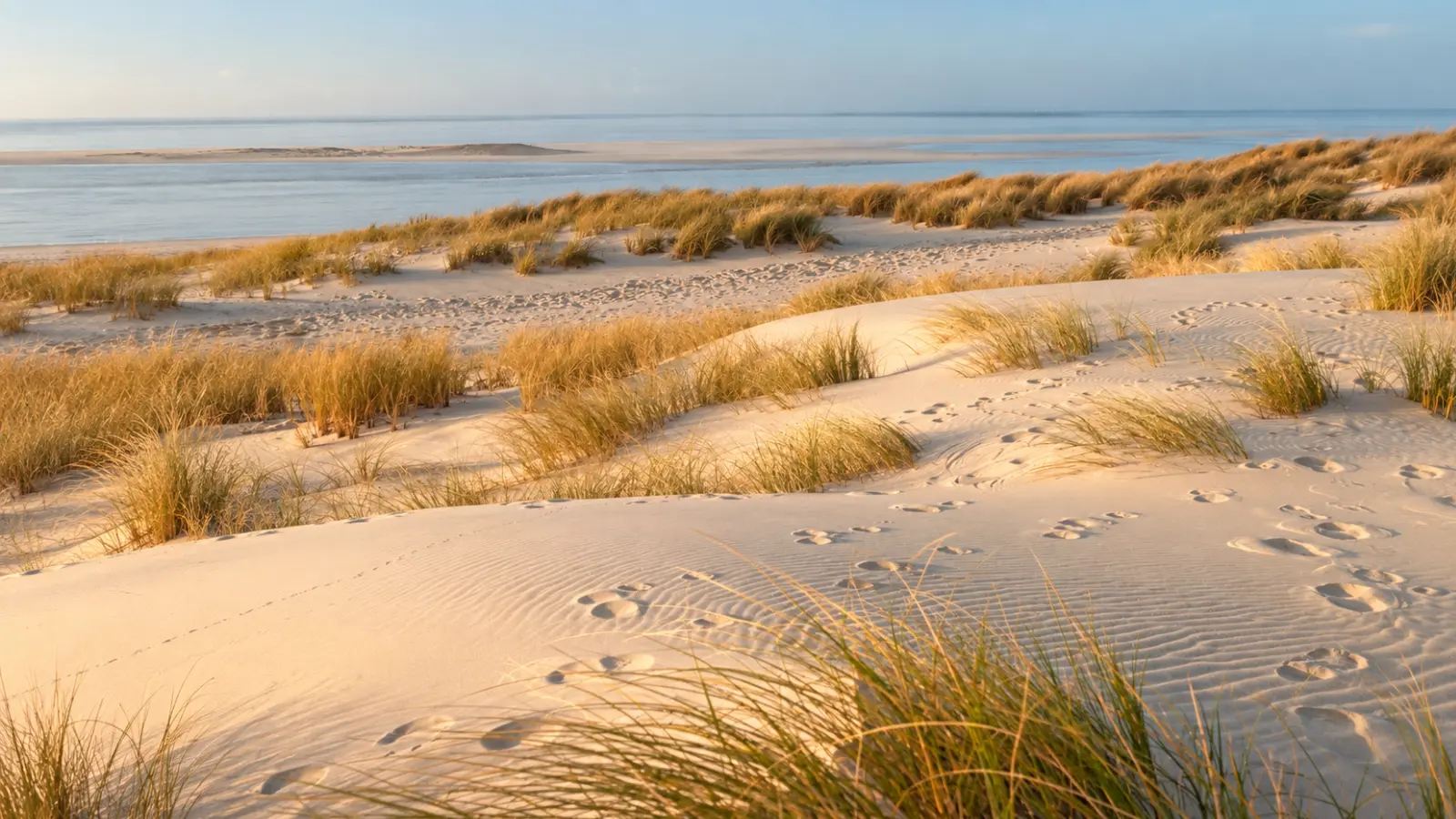
Dunes are not simply piles of sand waiting for ornamental plants. They are dynamic landforms that buffer the shoreline against wind, waves, erosion and storm surge. Native dune vegetation anchors sand and supports habitat. Foot traffic, digging, inappropriate planting and grade changes can compromise that system in ways that take years to repair — and that can redirect erosion onto neighboring properties.
Do not collect plants, seed or cuttings from natural coastal areas unless the activity is explicitly permitted and follows local conservation rules. Purchase plants propagated from known sources through nurseries that specialize in local coastal species.
If a property borders a dune, wetland, beach or protected shoreline, check local and state regulations before changing the grade, adding structures or planting within the sensitive buffer zone. Many coastal states have specific setback and vegetation requirements for properties near the shoreline, and changes that seem minor on a homeowner scale can have measurable effects on the stability of the larger coastal system.
Choose Salt-Tolerant Coastal Plants
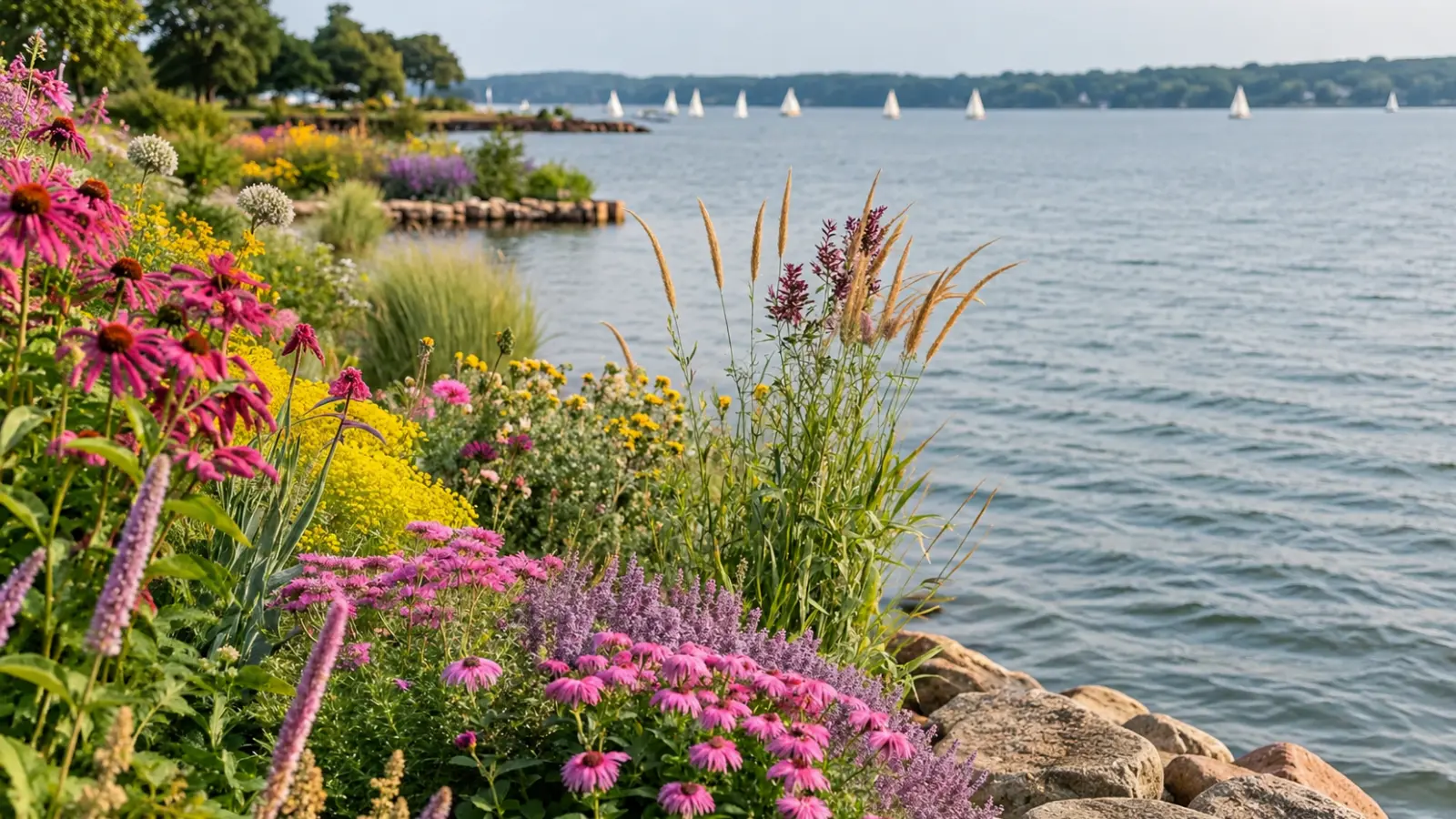
Salt tolerance varies by plant part, exposure type and regional context. Some species tolerate salt spray on their foliage but struggle in saline soil; others survive in salt-affected ground but are damaged when leaves are repeatedly coated. Regional plant lists that specify tolerance by exposure type are more useful than generic “coastal plant” labels.
Native coastal species are usually the most reliable starting point because they are already matched to local soil, weather, wildlife and shoreline processes. They also tend to anchor soil effectively and support native insects and birds. Adapted non-native plants may be useful in the protected interior of the garden, but investigate invasive potential carefully before planting — and check your specific state’s list, since status varies significantly by region. Rosa rugosa, for example, is widely sold as a salt-tolerant coastal shrub and performs well in those conditions, but it is listed as invasive in several New England states and parts of Canada, where it spreads aggressively through beach dunes.
For a functional coastal planting, aim for a mixture of forms:
- Low grasses and groundcovers that hold soil and reduce wind at ground level
- Flowering perennials suited to the local coast and its specific sun and salt exposure
- Shrubs on the windward side that tolerate salt and create meaningful shelter for plants behind them
- Small trees placed where their mature canopy, root zone and weight are safe during storms
- Evergreen or semi-evergreen plants for year-round screening and structure where the climate allows
- Plants with berries, seeds or flowers that support coastal wildlife
Before purchasing any plant, verify its mature size, cold tolerance, salt tolerance rating, water needs and current invasive status in your state. A plant that looks fine at a protected coastal nursery may struggle significantly in a directly exposed yard — the nursery conditions are rarely as harsh as the actual site.
Irrigate During Establishment
Even well-chosen salt-tolerant plants need consistent water while their roots are establishing. Sandy coastal soil dries out faster than most gardeners expect, and wind accelerates moisture loss from both foliage and the soil surface simultaneously.
Use irrigation that places water directly near the root zone without repeatedly wetting foliage. Drip irrigation is particularly effective in coastal gardens: it reduces evaporation, doesn’t add salt through overhead spray drift and can be adjusted as plants grow. Inspect the system regularly for leaks, clogged emitters and runoff patterns, and adjust frequency based on soil moisture, plant size, season and recent rainfall rather than a fixed schedule.
Group plants with similar water needs. A dune-adapted grass should not share an irrigation schedule designed for a moisture-demanding shrub near a sheltered entrance. When irrigation water has elevated salt content — which is not uncommon near the coast — periodic deep watering with low-salt water can help move accumulated salts below the root zone, but this approach only works where drainage allows salts to move downward rather than pool.
Design for Storm Resilience
No planting can be guaranteed to withstand every hurricane, nor’easter, atmospheric river or major coastal storm. Resilience in a coastal garden comes from reducing predictable vulnerabilities through design and plant selection — not from assuming that the right combination of plants eliminates risk.
Leave enough space for plants to reach their mature root spread and canopy without crowding. Avoid top-heavy growth in exposed positions; a plant that grows tall and narrow before its roots are deep is more likely to uproot during storms. Keep large trees and heavy specimens away from structures unless a certified arborist has assessed their storm risk. Use flexible plants that bend rather than break and layered shelter rather than one exposed specimen expected to block all wind on its own.
Manage stormwater flow so it doesn’t concentrate against foundations, wash planting soil toward the shore or pool around roots for extended periods. After storms, inspect for uprooted plants, broken branches, erosion channels, buried crowns and salt injury on foliage. Prune damaged growth cleanly and address the site condition that caused the failure where possible, rather than simply replanting the same plant in the same vulnerable spot.
Choose Materials for Coastal Exposure
Salt air accelerates corrosion faster and farther from the water than most people expect — atmospheric salt can travel several hundred yards inland during strong onshore winds, and its effects on standard hardware and fixtures show up within years, not decades.
For metal hardware, fasteners, railings and irrigation components in direct coastal exposure, marine-grade 316 stainless steel provides substantially better chloride resistance than the more common 304 grade. The difference is meaningful: 304 stainless can pit and show rust within a few years in consistent salt air, while 316 holds up considerably longer. For structural fasteners in direct coastal applications — deck screws, joist hangers, post hardware — specifying 316 from the start avoids failures that are expensive and sometimes dangerous to correct later.
For outdoor furniture and fixtures, powder-coated aluminum, marine-rated teak and composite materials designed for coastal conditions all offer reasonable durability. Whatever the material, regular rinsing — particularly of joints, hinges and undersides where salt accumulates unseen — extends service life significantly. Inspect hardware annually and replace components showing early corrosion before they become structural problems.
Use hardscape carefully around plants. Pale stone, concrete and light sand can reflect heat and light upward onto foliage. Provide shade or planting distance where hardscape could add a meaningful layer of heat stress to plants already managing wind and salt.
Maintain a Coastal Garden
Inspect the garden after strong winds and heavy rain. Check irrigation lines, drainage channels, plant supports, branches, erosion patterns and any signs of salt injury. Rinsing salt from foliage with fresh water after major spray events can reduce damage to plants in indirect exposure zones — it’s a reasonable practice after storms rather than a routine weekly task, and it only makes sense when local water quality allows and runoff won’t affect sensitive coastal areas.
Keep weeds under control, and pay particular attention to invasive coastal plants that can spread into dunes, wetlands or natural shoreline vegetation. A fast-spreading ornamental that tolerates salt is not automatically appropriate for a coastal garden — its spreading behavior near sensitive habitat makes it more problematic, not less. Check with your state’s invasive species program before planting anything with a reputation for aggressive spread near the shore.
Prune for structure and wind clearance rather than forcing plants into dense shapes that catch more wind than they deflect. Refresh mulch when needed, maintain paths and drainage routes, and replace plants that repeatedly fail because the exposure exceeds their actual tolerance. Honest reassessment of what isn’t working is more efficient than correcting the same problems every season.
Seasonal preparation matters in a coastal garden. Secure or store movable furniture and objects before storm season begins, inspect trees for weak or crossing branches and review whether any new growth has blocked drainage or sightlines. In hurricane and nor’easter regions, that seasonal review is more important than any single maintenance task.
Design for the Exposure You Actually Have
A successful coastal garden begins by understanding how salt, wind, soil, drainage and storms behave on the specific property. The most exposed areas may need exceptionally tough plants and layered shelter, while protected pockets can support a much broader planting palette.
Choose plants for your regional coast, protect sensitive shoreline systems and let the landscape become more sheltered as the planting matures. When exposure drives the design instead of a generic beach aesthetic, the garden can become more resilient, functional and naturally connected to its coastal setting.
COMMON QUESTIONS
Before you begin.
What is a coastal garden?
A coastal garden is a landscape designed for shoreline conditions such as salt spray, strong wind, sandy or rocky soil, intense light and storm exposure. It is defined by how the garden responds to those environmental stresses rather than by a particular visual style. Plant selection and design should reflect both the property’s exposure level and the climate of its specific coastal region.
What are the best plants for a coastal garden?
The best coastal garden plants are species that tolerate the site’s actual combination of salt, wind, soil, sunlight and winter conditions. Regionally appropriate native grasses, groundcovers, flowering perennials, shrubs and small trees are often strong choices because they are already adapted to local coastal conditions. Always verify salt tolerance, mature size, cold hardiness, water needs and invasive status rather than relying on a generic “coastal plant” label.
What plants can tolerate salt spray near the ocean?
Directly exposed areas need plants with high tolerance to both salt spray and strong wind, often including tough coastal grasses, low groundcovers and durable shrubs adapted to the local shoreline. More sheltered areas behind dunes, buildings or established windbreaks can support a wider range of moderately salt-tolerant plants. Salt tolerance of foliage and tolerance of saline soil are not always the same, so both should be considered.
How do you protect a coastal garden from strong wind?
Use layered, permeable wind protection rather than relying on a solid wall. Place the toughest low-growing plants and shrubs on the windward side, followed by larger shrubs or small trees and then more sensitive plants in the protected interior. This arrangement slows wind gradually and reduces salt exposure without creating the strong turbulence that can form behind solid barriers.
How do you improve sandy soil in a coastal garden?
First determine whether improvement is actually necessary, because many native coastal plants are adapted to lean, rapidly draining sand. For ornamentals that need greater moisture and nutrient retention, organic matter can be incorporated selectively rather than enriching the entire site. Also test drainage and soil conditions before amending, since some coastal properties contain compacted fill, clay layers or high water tables despite having sandy soil at the surface.
Do coastal gardens need irrigation?
Yes, especially while new plants are establishing. Sandy soils and persistent wind can dry root zones quickly, so even salt-tolerant and native coastal plants often need consistent supplemental water at first. As plants mature, irrigation can usually be reduced according to species, rainfall and local conditions, with water delivered directly to the root zone whenever possible.