A desert garden is designed around more than drought. Intense sun, reflected heat, dry air, wind, limited rainfall, sudden storm runoff and winter temperature swings all influence which plants will thrive and how the landscape should be arranged.
The right approach also depends on the desert itself. The Sonoran, Mojave, Chihuahuan and Great Basin deserts differ in rainfall patterns, elevation, summer heat and winter cold, so plants described broadly as “desert adapted” are not necessarily suitable for every arid region.
This guide explains how to design a desert garden, including how to evaluate sun and heat, create useful shade, manage desert soil and drainage, capture flash-flood rainfall, choose native and adapted plants, organize hydrozones, irrigate efficiently, select mulch and hardscape, protect plants from cold snaps and maintain the landscape as it matures.
What Is a Desert Garden?
A desert garden is a landscape designed around the conditions of an arid or semi-arid environment. It may include native desert trees, shrubs, cacti, succulents, grasses, flowering perennials and annuals, provided they are suited to the site and the specific desert region.
Desert environments are neither empty nor uniform. They contain dry washes, rocky slopes, sandy flats, mountain foothills and irrigated urban pockets, each with different soil, temperature and moisture patterns. A plant adapted to a desert wash may need more moisture than one from an exposed rocky slope. A plant that thrives in the low Sonoran Desert may not survive a Mojave winter.
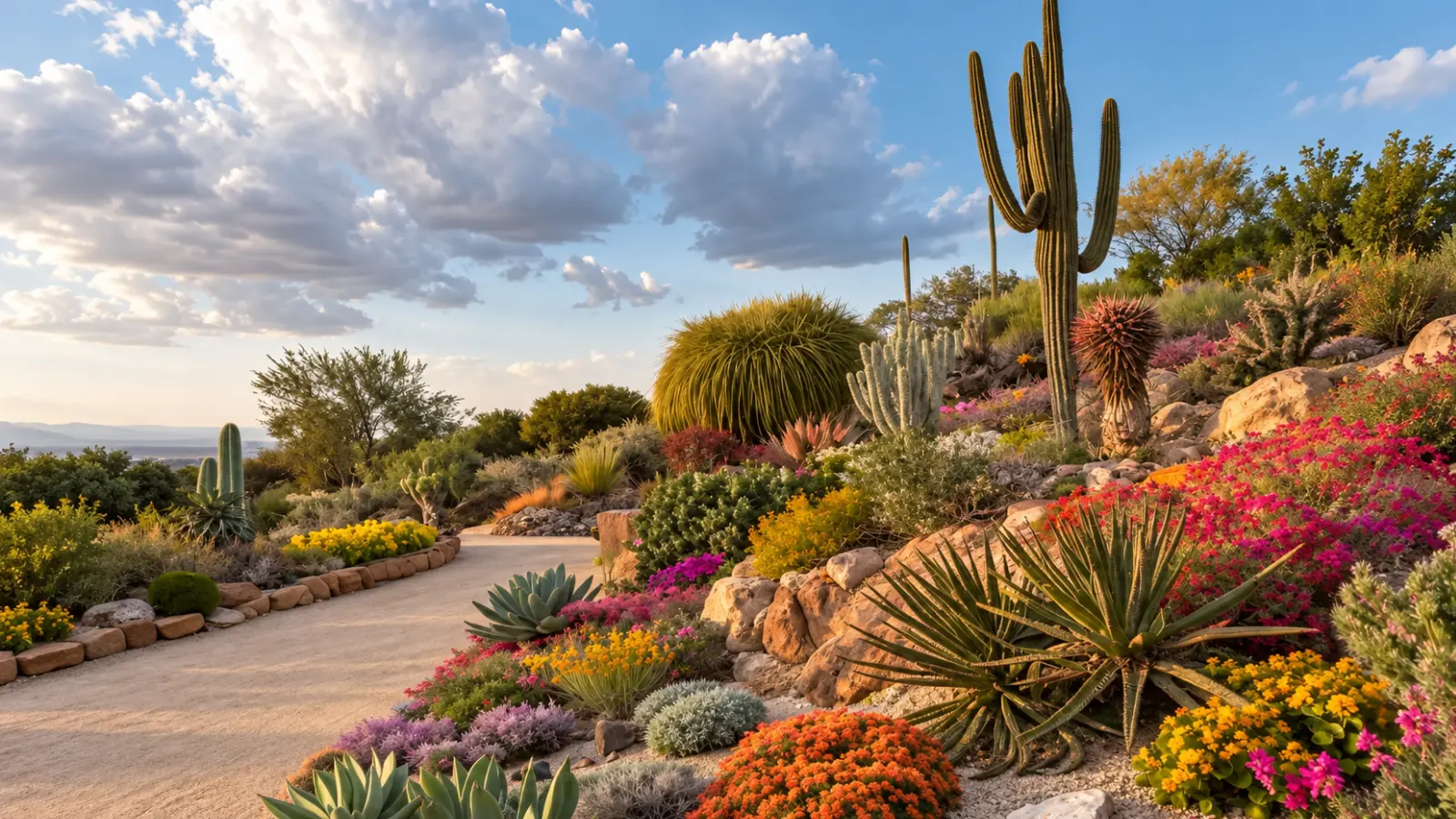
A desert landscape can be colorful, layered and genuinely welcoming without copying the appearance of the surrounding natural desert exactly. Place plants with similar needs together, protect delicate species from reflected heat, leave enough space for mature growth and let the regional character guide the design rather than overriding it.
Desert Garden vs. Xeriscape
These two terms are often used interchangeably, but they describe different things. A desert garden refers to the environment and the plant community the landscape is designed to support. Xeriscape refers to a set of water-efficiency principles that can be applied in a desert, Mediterranean climate, high plains or other region.
A desert garden may follow xeriscape principles, but it also involves specific challenges that xeriscaping alone doesn’t address: intense solar radiation, hot hardscape, monsoon rainfall patterns, alkaline or caliche-heavy soil and, in many desert regions, the real threat of freezing temperatures. Xeriscaping organizes water use; desert gardening requires working with the full complexity of an arid climate.
The broader principles of xeriscape gardening can help structure water planning, while this page focuses on the conditions specific to an arid landscape.
Understand Your Desert Region
One of the most common desert garden mistakes is selecting plants labeled “desert-tolerant” without considering which desert. North America has four distinct desert ecosystems, and they differ significantly in heat, cold, rainfall timing, elevation and dominant plant communities.
The Sonoran Desert (southern Arizona, southeastern California, northwestern Mexico) is the most plant-rich of the four. It receives both summer monsoon rain and winter moisture, which supports a remarkable diversity of cacti, trees and shrubs, including saguaro, palo verde, desert willow and ironwood. Mild winters in the low desert allow frost-sensitive plants that would fail elsewhere.
The Mojave Desert (southern Nevada, southeastern California, small areas of Utah and Arizona) receives most of its precipitation in winter and has dry, intensely hot summers. It includes Joshua Tree as a signature plant and experiences more extreme temperature swings than the Sonoran. Death Valley, located in the Mojave, regularly records the highest air temperatures on Earth.
The Chihuahuan Desert (western Texas, southern New Mexico, extending into Mexico) sits at higher elevation than the Sonoran and Mojave, giving it cooler winters and a shorter frost-free season. It receives most of its rain in summer. Many plants labeled as desert-adapted for Arizona may not survive a Chihuahuan winter without protection.
The Great Basin Desert (Nevada, Utah, southern Idaho, parts of Oregon) is a cold desert — its elevation and latitude mean hard winters, and its dominant plants reflect that: sagebrush, rabbitbrush, bitterbrush and basin grasses rather than the cacti and succulents that define warmer deserts. USDA Hardiness Zones 6 and 7 apply across much of the region.
Use local Cooperative Extension resources, native-plant societies, botanical gardens and regional nurseries to identify plants that genuinely perform in your area. USDA Hardiness Zone helps evaluate winter cold, but it does not describe summer heat, reflected radiation, rainfall timing, humidity or soil chemistry — all of which vary significantly even within a single desert.
Also confirm whether a plant is native to your local ecosystem or adapted from a similar climate elsewhere. Adapted non-natives can have a place in a designed landscape, but evaluate them for invasive potential, water use and habitat value before planting.
Study Sun, Heat and Wind
Map the site thoroughly before planting. Record where full sun falls at different times of day, identify afternoon exposure hot spots, note areas where walls and pavement reflect radiation onto nearby plants, mark wind corridors and find the low pockets where cold air settles at night.
South- and west-facing walls and paving can generate extreme heat, especially when masonry or concrete directs radiation onto nearby plants. A plant that handles open desert sun without complaint may still fail beside a hot stucco wall because the reflected heat exceeds what it’s adapted to. Use shade, distance and appropriate plant selection to reduce that stress, rather than simply choosing the toughest plant available and hoping for the best.
Wind increases water loss and can damage tall stems or broad leaves, particularly during establishment. Fences, walls and well-placed shrubs create useful shelter, but solid barriers can also create turbulence on the lee side. Plan wind protection as part of the original layout rather than adding it after plants begin to struggle.
Plan Shade for People and Plants
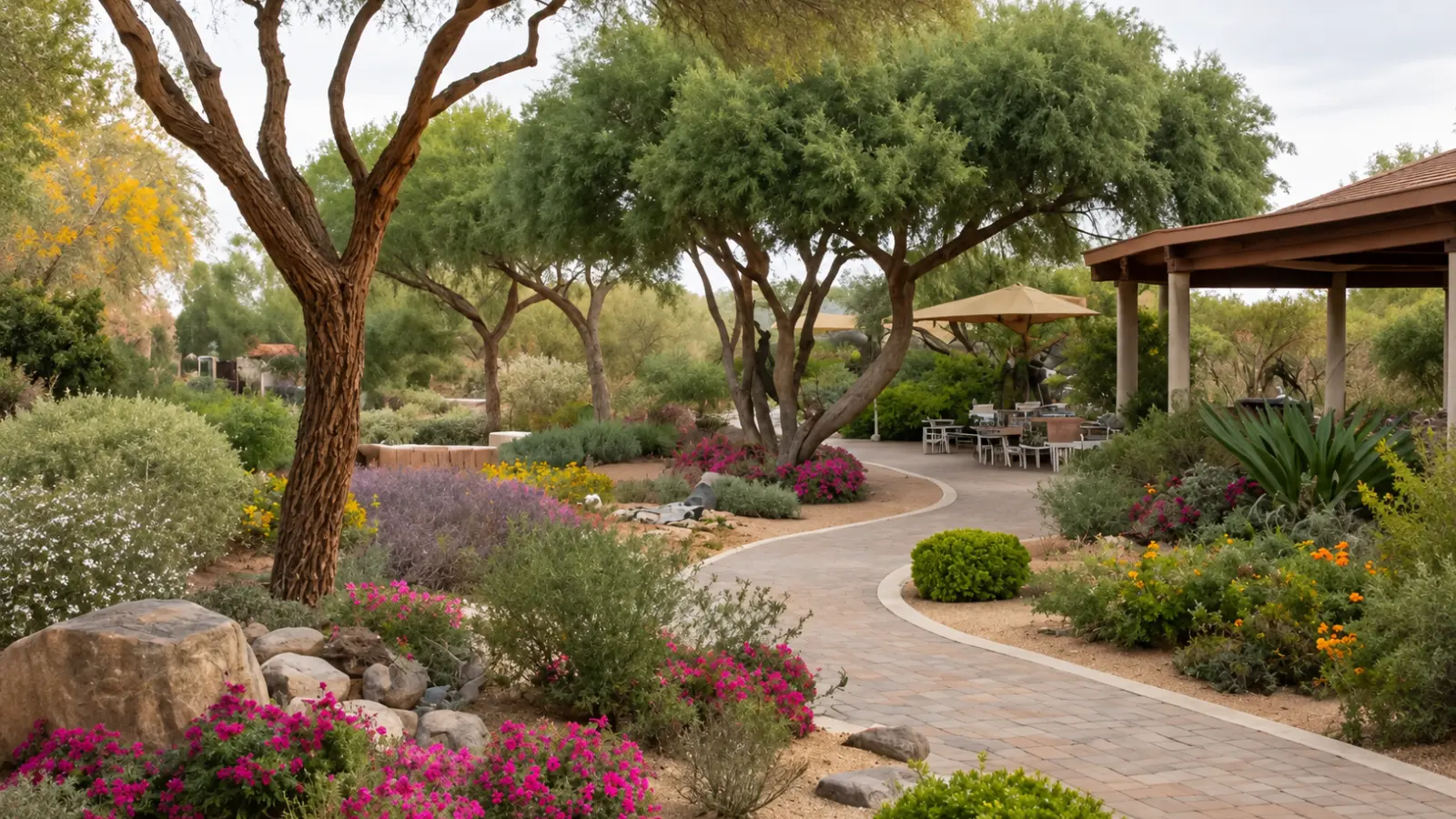
In a desert garden, shade is one of the most practical design resources available. A well-placed tree can improve human comfort, protect lower plants from intense afternoon sun and meaningfully reduce the surface temperature of nearby hardscape — sometimes by 20°F or more on paving directly under a canopy.
Deciduous trees offer summer shade while allowing more winter sun through, which matters in desert climates where winter warmth is welcome. Evergreen trees provide more consistent screening year-round. Neither choice is universally better; the right one depends on orientation, use and what’s growing nearby.
Before planting any tree, account for its mature canopy spread and root zone, water needs at maturity, litter (seedpods, thorns, fruit), distance from structures and underground utilities. If you’re converting an established irrigated landscape, check whether existing trees have come to depend on the current watering schedule before you remove it. Reducing or eliminating irrigation around a mature tree that has grown accustomed to regular water can cause serious decline.
Shade structures — pergolas, ramadas, shade cloth — can extend the usable season and protect tender plants in exposed spots, but they work best when they’re part of the design rather than a workaround for poor plant selection.
Manage Soil and Drainage
Desert soils are far more variable than the word “arid” suggests. They may be sandy, rocky, alkaline, compacted, saline or heavy with clay. Don’t assume that arid soil drains freely. Clay soils can hold water around plant roots well after the surface looks dry, and even sandy desert soils can become waterlogged above a hardpan layer.
One of the most important soil issues in many desert regions — particularly the Sonoran — is caliche, a hardened layer of calcium carbonate that forms below the soil surface. Caliche can be a few inches thick or several feet, and it restricts both root penetration and water drainage. Before planting trees or large shrubs in affected areas, test drainage by filling the hole with water and watching whether it drains within 12 to 24 hours. If it doesn’t, caliche or compaction is likely the cause. Breaking through the layer with a tile bar or, in stubborn cases, a jackhammer, can be necessary for larger plantings. Raised beds offer a practical alternative where caliche is dense or extensive.
Desert soils also tend to be alkaline — often pH 7.5 to 8.5 — which can limit the availability of iron and other micronutrients even when those elements are physically present in the soil. Most native desert plants are adapted to alkaline conditions and don’t need acidifying amendments. Non-native plants that prefer more neutral soil may show interveinal chlorosis (yellow leaves with green veins) as a symptom of iron deficiency caused by high pH.
When amending soil, be selective. Native and desert-adapted plants generally perform better in lean, mineral soil than in heavily enriched beds, and organic compost mixed into planting holes can create a perched water table that keeps roots saturated after storms. The University of Arizona Cooperative Extension recommends against adding organic matter to planting holes for native and arid-climate plants for this reason — the plant needs to push roots into the surrounding native soil, not stay comfortable in an amended pocket. For very sandy or rocky soils with poor water retention, incorporating some fine-textured native soil into the planting hole can help without creating drainage problems.
Work With Flash-Flood Rainfall
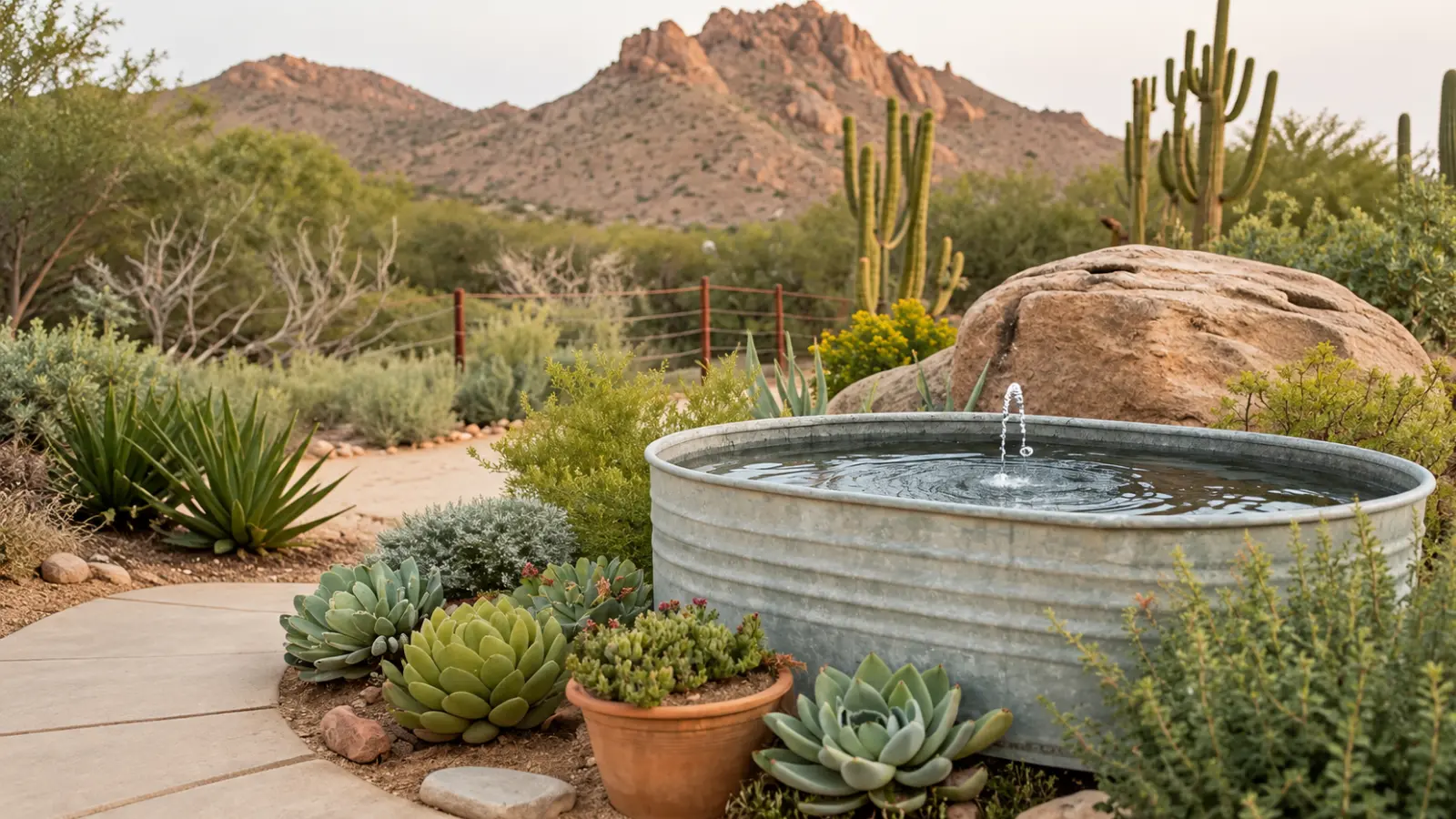
Arid climates can deliver intense rainfall in very short periods. A landscape that needs irrigation for most of the year may still need to handle sudden, heavy runoff during monsoon season — and that runoff can be both an asset and a problem, depending on how the site is designed.
Observe where water moves across the property during and after a storm before you finalize any planting plan. Identify where soil erodes, where runoff pools and where it naturally flows toward structures, paths or neighboring properties. These observations are more reliable than guessing from a dry-season walk.
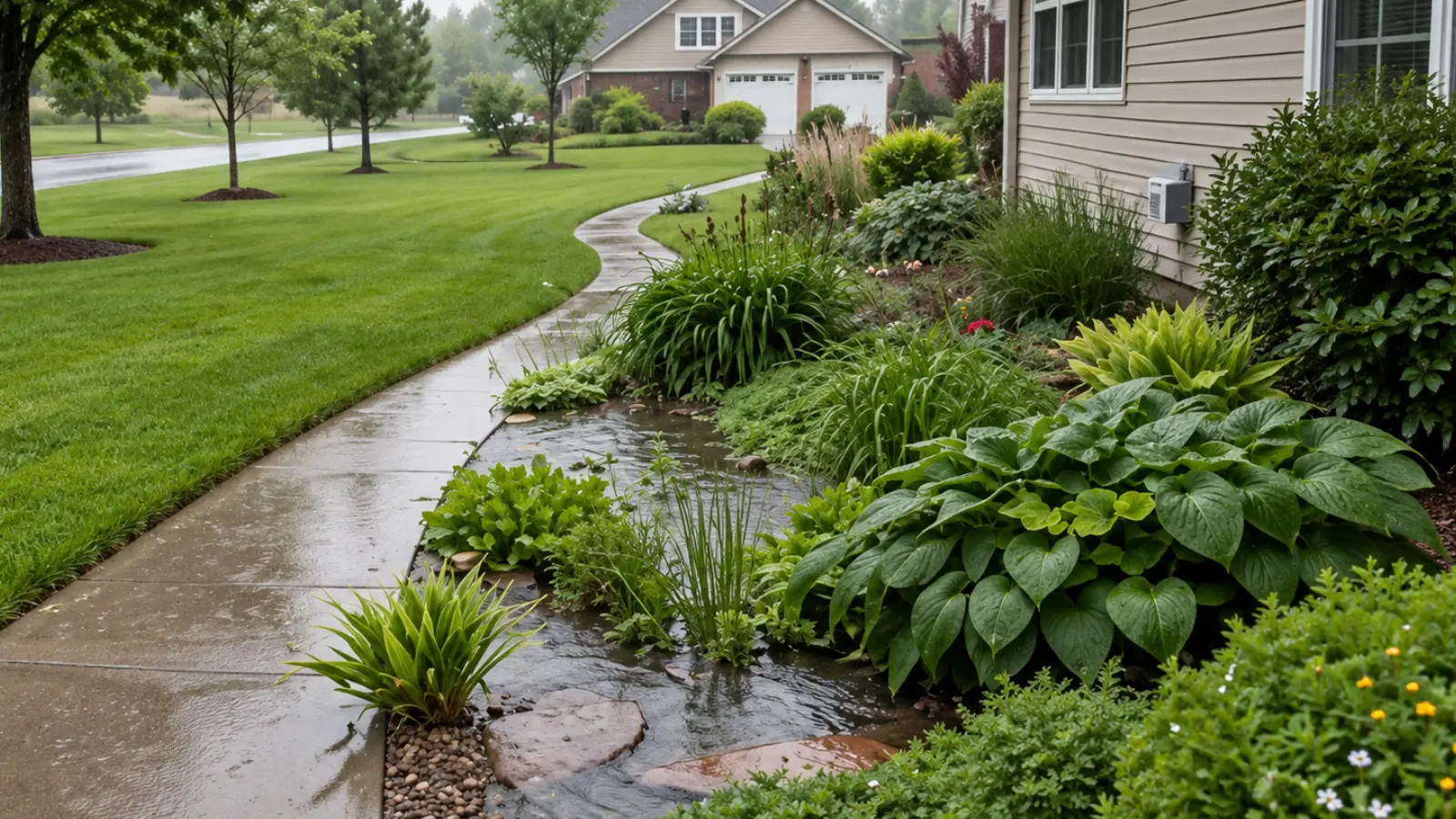
Rather than simply draining stormwater away, consider directing it to where plants can use it. Shallow basins around trees and shrubs, planted swales running along contour lines and berms that slow sheet flow can all help water infiltrate the soil near root zones instead of running off. The principle — slow it, spread it, sink it — turns a potential problem into a significant irrigation resource, especially in Sonoran and Chihuahuan desert regions where monsoon rain can be substantial.
Do not place plants with dry-crown requirements in low spots where stormwater collects after storms. A plant may tolerate drought and still fail when its roots remain saturated for days after a heavy rain event. When drainage modifications affect grading, structures, public paths or significant slopes, consult a qualified local professional.
Choose Native and Adapted Plants
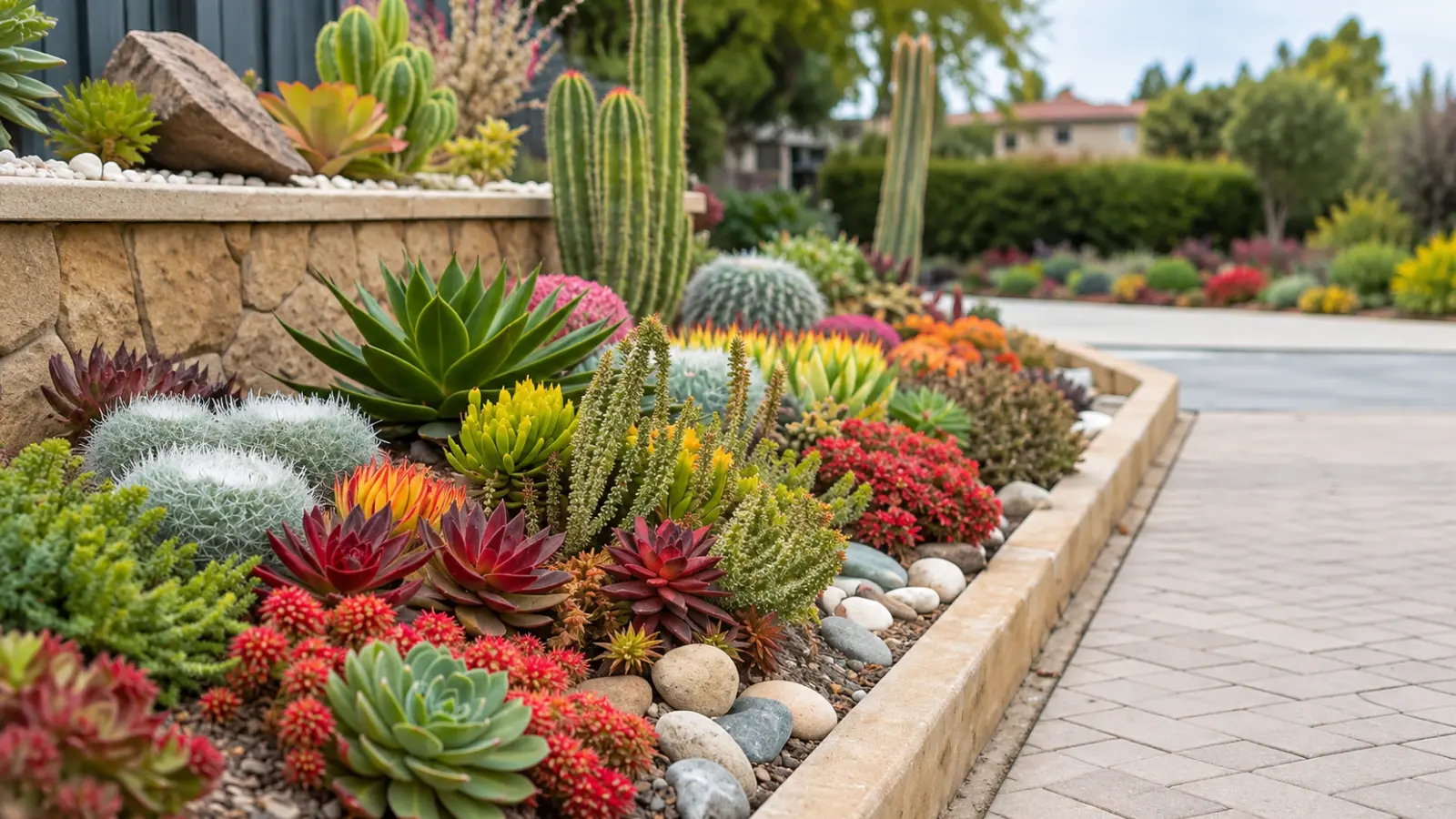
Native desert plants are valuable when they belong to your specific regional ecosystem and match the garden’s actual conditions. They support local insects and birds, align with the seasonal rhythm of the climate and, once established, often require less supplemental water than adapted ornamentals from elsewhere.
Adapted plants from other dry regions — Mediterranean shrubs, South African succulents, Australian acacias — can expand the design palette, but they require careful evaluation. Consider mature size, water use, cold tolerance, root behavior, spine or thorn hazard, toxicity to children or pets, maintenance requirements and invasive potential before committing to a placement.
A varied desert garden might include:
- Native or adapted shade trees where space, root zone and water budget allow
- Flowering shrubs for structure, seasonal color, screening and pollinator habitat
- Cacti and succulents in well-drained planting pockets with appropriate drainage
- Desert-adapted ornamental grasses for movement, texture and seasonal interest
- Flowering perennials and desert annuals for seasonal color with low water demands
- Low groundcovers that soften gravel areas and reduce heat at ground level
Read plant labels and regional references carefully, and cross-reference them with local Extension or botanical garden resources. A plant described as drought-tolerant may still need substantially more water than the native species growing around it, particularly in a hot urban microclimate where reflected heat adds stress beyond what any label can anticipate.
Create Hydrozone Planting Areas
Hydrozoning — grouping plants by water need — is one of the most practical tools in desert garden design. It lets you adjust irrigation frequency and volume for each zone without over- or under-watering plants that belong to different communities. Mixing a cactus that needs dry conditions with a flowering perennial that needs weekly summer water forces a compromise that serves neither plant well.
| Zone | Typical Plants | Placement | Water Approach |
|---|---|---|---|
| Low water | Regional desert shrubs, cacti and adapted succulents | Open, sunny areas with rapid drainage | Deep, infrequent supplemental water after establishment; rain-dependent thereafter |
| Moderate water | Flowering perennials, ornamental grasses and some shrubs | Transitional areas, filtered shade or east-facing exposures | Seasonal irrigation adjusted by plant response and soil moisture, not a fixed schedule |
| Higher water | Selected shade trees, lush focal plants and containers | Entry areas, gathering spaces or protected microclimates | Separate irrigation circuit with regular emitter checks and seasonal adjustment |
When a single plant with higher water needs is mixed into a low-water bed, the rest of the planting ends up getting more water than it should. The better fix is to move the out-of-place plant to a more suitable zone — not to irrigate the whole bed to accommodate it.
Use Efficient Irrigation
Efficient irrigation matters in any garden, but in a desert it determines the health of the entire landscape. Evaporation is high, and water applied at the wrong time, in the wrong place or in the wrong amount can be lost before roots ever reach it.
Drip irrigation and low-volume emitters are the most practical choice for most desert plantings because they deliver water directly to the root zone with minimal evaporative loss. Placement is critical — emitters should sit at and slightly beyond the plant’s dripline, not against the trunk, and their position should move outward as the plant grows. A drip emitter still aimed at the original planting spot two years later is watering the wrong area.
New plants require more frequent irrigation than established ones. General guidance from the Arizona Municipal Water Users Association suggests watering new native and desert-adapted shrubs every one to two days during the first two weeks in summer, tapering to once every four to six days by weeks five and six, then gradually extending intervals as roots develop. Shrubs typically establish within about one year; trees generally take two to three years, and sometimes longer. Deep, infrequent watering during establishment encourages roots to follow moisture downward, building resilience against drought.
Inspect the system regularly for leaks, clogged emitters, overspray and pooling. Water should not repeatedly strike trunks, sit around crowns or spray onto hot pavement where it evaporates immediately. Use separate irrigation zones for trees, shrubs, succulents and any higher-water focal plants — not because the schedule will always differ drastically, but because you need the flexibility to adjust each independently as conditions change.
Choose Gravel and Organic Mulch
Mulch choice in a desert garden isn’t one-size-fits-all. The right material depends on the plant community, drainage needs and the microclimate you’re working with.
Gravel and decomposed granite suit most cacti, succulents and low-water desert shrubs well. They drain quickly, reflect the mineral character of arid habitats and don’t create the wet-crown conditions that can rot drought-adapted plants. Use a depth that doesn’t bury plant crowns or trap heat so intensely that it harms roots near the surface — two to three inches is a reasonable range for most applications.
Organic mulch — shredded wood, bark or compost — works better around trees, large shrubs and plants that benefit from cooler soil and gradual improvement of organic matter content. It reduces evaporation and moderates soil temperature, but it should not rest against drought-adapted stems or pile up around crowns where it traps moisture.
Neither type of mulch eliminates weeds, especially after monsoon rain when disturbed soil sprouts quickly. Remove invasive weeds early before they set seed, and choose the surface material according to the plant community in each zone rather than covering the entire landscape with a single uniform product.
Use Heat-Reflective Hardscape Carefully
Stone, concrete, decomposed granite, gravel and metal all absorb and radiate heat at levels that can meaningfully raise temperatures in the surrounding microclimate. Hardscape adds structure, paths and useful outdoor living space, but its placement relative to plants, seating areas and building entrances deserves careful thought.
Light-colored or highly reflective surfaces can bounce radiation onto adjacent plants and walls, raising surface temperatures well above ambient air temperature. A cactus may tolerate full desert sun without damage and still show bleaching or sunscald when positioned beside a white stucco wall or pale concrete patio that focuses reflected heat onto one side of the plant.
Use shade trees, pergolas, ramadas, surface color choices and thoughtful plant-to-hardscape distances to moderate heat in areas where people gather. Keep plants with delicate foliage or pale coloring away from the most reflective surfaces unless you’ve observed how that specific spot behaves through a full summer. A desert landscape should also remain genuinely comfortable to use — shade, accessible paths and places to pause make it more than an exhibit of tough plants.
Protect Plants From Cold Snaps
Cold is one of the most underestimated factors in desert garden planning, particularly for gardeners new to arid climates. Many desert regions experience genuine winter freezes, and even the low Sonoran Desert — known for its mild winters — can see temperatures drop below 32°F during clear, calm nights in December and January.
A plant can tolerate months of 110°F summer heat and still be killed or damaged by a single hard freeze if it wasn’t selected for the local cold tolerance range. Use USDA Hardiness Zone ratings as a starting point, but also check frost date records specific to your location, since cold air drains into low pockets and basin floors can be several degrees colder than surrounding slopes and hillsides on still nights.
Avoid placing frost-sensitive plants in landscape low points or against north-facing walls with no winter sun. Courtyards, south-facing slopes, tree canopies and protected patios create warmer microclimates that can extend the range of marginally hardy plants — but they don’t eliminate freeze risk entirely.
When a freeze is forecast, follow guidance from your local Cooperative Extension office for the specific plants involved. Covering tender plants with frost cloth (not plastic, which can trap damaging moisture or heat up too quickly in morning sun), moving containers to a protected location and managing irrigation in the days before a freeze can all reduce damage. Do not use heat sources — heat lamps, incandescent strings or similar devices — in ways that create fire or burn risk near dry plant material.
Maintain a Desert Garden
A desert garden is not a no-maintenance landscape. It is, with time and good plant selection, a lower-maintenance one. The ongoing work includes irrigation monitoring, weed removal, pruning, mulch management and seasonal observation — but the nature of that work changes as plants mature and root systems develop.
Prune according to the plant’s natural form rather than shearing every shrub into a tight geometric shape. Most desert natives look and perform better with selective pruning that removes dead, diseased or crossing growth while preserving the plant’s natural architecture. Preserve useful seedheads and winter structure when they don’t interfere with paths or sightlines — they provide habitat and visual interest through the dormant season.
Watch for weeds in the weeks after monsoon storms, when disturbed soil can produce rapid germination. Check for erosion after flash-flood events and repair drainage channels before small problems grow into large ones. Reassess spacing as plants mature — crowding increases irrigation needs, reduces airflow and makes routine maintenance harder than it needs to be.
The most honest maintenance habit is periodic reassessment: if a plant consistently needs more water, shade or protection than the site can reasonably provide, replacing it with a better match is almost always more efficient than continuing to compensate for the same problem season after season.
Design for the Whole Desert Climate
A successful desert garden responds to the complete environment, not just the lack of rainfall. Heat, reflected radiation, soil, drainage, wind, intense storms and winter cold all shape where plants belong and how much support they will need.
Start with species suited to your specific region, then organize the garden around shade, water zones and the way rainfall moves through the property. When each plant is matched to the conditions it can actually handle, the landscape becomes more resilient, comfortable and visually connected to the climate around it.
COMMON QUESTIONS
Before you begin.
What is a desert garden?
A desert garden is a landscape designed for arid or semi-arid conditions, including intense sun, limited rainfall, dry air, wind and significant temperature swings. It may combine desert-adapted trees, shrubs, cacti, succulents, grasses and flowering plants rather than relying only on gravel and cactus. Successful plant choices should match the specific desert region, soil, drainage and local winter temperatures.
How do you design a desert garden?
Start by mapping sun exposure, reflected heat, wind, drainage and natural stormwater movement across the site. Choose plants suited to the local desert region, group them into hydrozones based on water needs, provide strategic shade and leave enough room for mature growth. Efficient irrigation, appropriate mulch and safe management of runoff should be planned before planting rather than added later.
What are the best plants for a desert garden?
The best plants are species adapted to your specific desert climate and microclimate rather than plants simply labeled “drought tolerant.” Depending on the region, a desert garden may include native or adapted shade trees, flowering shrubs, cacti, succulents, ornamental grasses, perennials, annual wildflowers and low groundcovers. Always check mature size, cold hardiness, water needs, drainage requirements and invasive potential before planting.
Does a desert garden need irrigation?
Yes, especially while plants are establishing. Newly planted shrubs may need supplemental irrigation for roughly a year, while trees can take two to three years or longer to develop sufficiently established root systems. Water deeply and gradually increase the interval between irrigations as plants mature, then provide supplemental water when local conditions or prolonged extreme heat require it.
What is the difference between a desert garden and a xeriscape garden?
A desert garden is specifically designed around the environmental conditions of an arid region, while xeriscaping is a broader water-efficient landscaping approach that can be used in many climates. Desert gardens often use xeriscape principles such as hydrozoning and efficient irrigation, but they must also address desert-specific issues including extreme heat, reflected radiation, alkaline or caliche soils, flash-flood rainfall and freezing temperatures.
Can desert plants survive freezing temperatures?
Some can, but cold tolerance varies greatly by species and desert region. Plants from colder deserts such as the Great Basin or higher-elevation areas may tolerate substantial freezes, while species from warmer desert environments can be damaged by a single cold event. Check USDA Hardiness Zone and local frost history, avoid placing tender plants in low frost pockets and protect vulnerable plants with appropriate frost cloth when freezing weather is forecast.